‘Social workers save lives. We are not child-snatchers or do-gooders’
Guardian Social Lives survey finds that although many professionals say
they love their jobs, a quarter plan to leave the sector in the next
five years
The Guardian. Retrieved from: http://www.theguardian.com/society/2015/dec/08/social-workers-survey-not-child-snatchers-love-jobs-leave-sector
Social Lives 2015 research: theguardian.com/social-care-network
There’s
perhaps never been a tougher time to be a social worker. Local
authority budgets are continuing to be squeezed, workloads are rising
and the arguments over whether social workers are being scapegoated are
intensifying. Not that social work has ever been a career for the
faint-hearted: complex and stressful caseloads and the media and
political backlash if things go wrong have made sure of that.
According to a new Guardian survey of social workers, an overwhelming 92% of respondents feel spending cuts are affecting service levels and putting increased pressure on social workers. This year’s Social Lives survey, carried out by Guardian Jobs in association with Affinity Workforce, shows that two-thirds of social workers say they can’t focus on what really matters in their jobs and three-quarters feel their workload is unmanageable. More than 80% feel they need to pay more attention to their own wellbeing, with 67% saying they have been affected by stress and depression.
Little wonder then, that of the 1,420 professionals across the UK who took part in the survey – across a variety of roles and specialities from children, to adults and mental health – almost a quarter plan to leave social work in the next five years. For those planning to stay, the motivation is clearly the satisfaction of making a difference to people’s lives. “A child said to me ‘I feel safe now’ and that made the whole year worthwhile,” said one respondent. “I like spending time with people, getting to know their stories and supporting them to make positive changes,” said another.
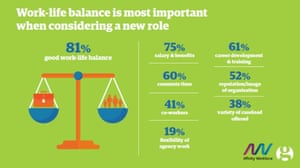
The survey findings tally with what the British Association of Social Workers (Basw) is hearing from the frontline, says Basw England manager Maris Stratulis. She meets dedicated and hard-working social workers all the time, she says, but increasingly they say they are overstretched. “We are hearing concerns about increasing workload and long hours. People are telling us they are so busy they can’t even fit time off into their diaries,” she says.
“There are real challenges of work-life balance, particularly for people who have been in social work for longer and who may have adult caring responsibilities or childcare responsibilities.”
Rachael Wardell, director of community services at West Berkshire council, says the financial pressures on local government are taking their toll. “Our social workers are clearly feeling it and I know as a manager and leader I feel it,” she says. “We don’t see there being much let-up in that. With all the proposals for continuing cuts, the ongoing expectation is that we will do more for less.”
The survey shows that most social workers and managers are doing overtime most days of the week – and for 86% of staff that overtime is unpaid.
“We are already squeezing a lot from our people and that’s a tough environment in which to work,” says Wardell, who is chair of the Association of Directors of Children’s Services’ workforce development committee. “Social workers carry exceptional responsibility every day. We are not training as many as we need and not keeping them in the profession after qualifying. I know that for a lot of my colleagues in both children’s and adult services, the key concern is how to recruit and retain good social workers at all levels.”
So just how to keep those who are planning to leave – and attract more people who will share the values that are at the core of a social worker’s job? Some of the stresses on the profession may be practical ones.
The physical environment is clearly a factor, with 57% of survey respondents saying hotdesking is not beneficial to their work with colleagues. Basw says that chimes with forthcoming research of its own, which suggests too many social workers are finding it hard to work either in old, vermin-infested buildings, or in the newer call centre-type facilities where they struggle to find a desk of their own. Many even have to sit in their car when they need to make a confidential phone call – and often their offices aren’t conducive to the mutual support so important to good social work, says Stratulis.

But wider than that, there’s clearly a need for social workers to feel valued both by their teams and employers and by the wider public. Michelle Lefevre, head of social work and social care at the University of Sussex, says new social workers need to go into the job with a realistic view of the challenges it will bring, but then need the right support as they progress. “It’s crucial that in the first year workloads are manageable so they have time to think and make the transition,” she says. “If you get it wrong, you set someone on the path to stress, perhaps depression, perhaps burnout.”
“People are working with families and individuals at the extreme end of tension, family stress and breakdown. What we have to produce is a generation of social workers who are able to work with that,” Lefevre says.
Then there’s the negative perception of the profession. Many who took part in the survey say more young people would be encouraged into social work if only its image could be improved. As one respondent put it: “The government and media need to stop portraying social workers as child-snatchers and do-gooders. They should sometimes focus on the lives we have saved and positively changed.”
“The media promotes a very negative image of social work that’s quite hard to counter,” Wardell agrees. “Our success stories are kept out of the spotlight, often out of respect for the people we work with, but our failures are everywhere.”
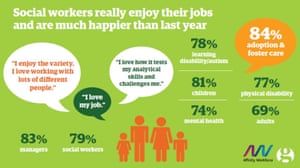
But despite these pressures, the vast majority of the social workers surveyed by the Guardian are encouragingly positive about the work they do. As many as 79% say they enjoy their jobs – up from the 63% who said they were happy in their role last year. The happiest social workers are in Wales (87%), followed by the east of England (85%) and the north-west (81%), compared to 69% in the-south west. Many say they still get immense satisfaction from the work. As one respondent puts it: “It is very rewarding and exciting, chaotic, challenging and fulfilling. You feel that all your skills are being employed all the time.”
Yet that passion for the job is being tested by the lack of recognition and support at a national level. “The government needs to stop making threats to imprison social workers [for ‘wilful neglect’]. It should be a respected profession as opposed to one that’s mocked and criticised,” said one respondent.
Stratulis says the wider political debate, such as moves to jail social workers who have fallen down in the job for “wilful neglect”, don’t help either. “I just don’t think social workers are getting the recognition at a national level - if anything they are being increasingly challenged and scapegoated,” she says. “We don’t have a narrative that’s supportive and values the profession. There’s too much challenge and focus on what’s presenting as poor social work. We don’t condone poor practice – but we are saying there are excellent social workers out there and excellent students coming into the profession and we have got to give them the support they deserve.”
Reinforcing and supporting the motivation that encourages people into social work in the first place will be a key challenge as the tough environment for social workers continues. Some feel the creation of principal practitioner posts will improve career progression and help to retain experienced staff, while others point to manageable caseloads and more investment in early intervention.
“Our frontline staff have to be supported,” says Wardell. “They absolutely need regular supervision, they need to be encouraged to develop the skills they have and offered support for their own resilience. It’s our responsibility to create the environment and the atmosphere that allows social workers to have professional confidence in their own practice and to feel supported in their role.”
Lefevre says: “That human desire to help others will never go away. If we can keep that alive for people in the profession it’s an amazing gift to service users.
According to a new Guardian survey of social workers, an overwhelming 92% of respondents feel spending cuts are affecting service levels and putting increased pressure on social workers. This year’s Social Lives survey, carried out by Guardian Jobs in association with Affinity Workforce, shows that two-thirds of social workers say they can’t focus on what really matters in their jobs and three-quarters feel their workload is unmanageable. More than 80% feel they need to pay more attention to their own wellbeing, with 67% saying they have been affected by stress and depression.
Little wonder then, that of the 1,420 professionals across the UK who took part in the survey – across a variety of roles and specialities from children, to adults and mental health – almost a quarter plan to leave social work in the next five years. For those planning to stay, the motivation is clearly the satisfaction of making a difference to people’s lives. “A child said to me ‘I feel safe now’ and that made the whole year worthwhile,” said one respondent. “I like spending time with people, getting to know their stories and supporting them to make positive changes,” said another.
The survey findings tally with what the British Association of Social Workers (Basw) is hearing from the frontline, says Basw England manager Maris Stratulis. She meets dedicated and hard-working social workers all the time, she says, but increasingly they say they are overstretched. “We are hearing concerns about increasing workload and long hours. People are telling us they are so busy they can’t even fit time off into their diaries,” she says.
“There are real challenges of work-life balance, particularly for people who have been in social work for longer and who may have adult caring responsibilities or childcare responsibilities.”
Rachael Wardell, director of community services at West Berkshire council, says the financial pressures on local government are taking their toll. “Our social workers are clearly feeling it and I know as a manager and leader I feel it,” she says. “We don’t see there being much let-up in that. With all the proposals for continuing cuts, the ongoing expectation is that we will do more for less.”
The survey shows that most social workers and managers are doing overtime most days of the week – and for 86% of staff that overtime is unpaid.
“We are already squeezing a lot from our people and that’s a tough environment in which to work,” says Wardell, who is chair of the Association of Directors of Children’s Services’ workforce development committee. “Social workers carry exceptional responsibility every day. We are not training as many as we need and not keeping them in the profession after qualifying. I know that for a lot of my colleagues in both children’s and adult services, the key concern is how to recruit and retain good social workers at all levels.”
So just how to keep those who are planning to leave – and attract more people who will share the values that are at the core of a social worker’s job? Some of the stresses on the profession may be practical ones.
The physical environment is clearly a factor, with 57% of survey respondents saying hotdesking is not beneficial to their work with colleagues. Basw says that chimes with forthcoming research of its own, which suggests too many social workers are finding it hard to work either in old, vermin-infested buildings, or in the newer call centre-type facilities where they struggle to find a desk of their own. Many even have to sit in their car when they need to make a confidential phone call – and often their offices aren’t conducive to the mutual support so important to good social work, says Stratulis.
But wider than that, there’s clearly a need for social workers to feel valued both by their teams and employers and by the wider public. Michelle Lefevre, head of social work and social care at the University of Sussex, says new social workers need to go into the job with a realistic view of the challenges it will bring, but then need the right support as they progress. “It’s crucial that in the first year workloads are manageable so they have time to think and make the transition,” she says. “If you get it wrong, you set someone on the path to stress, perhaps depression, perhaps burnout.”
“People are working with families and individuals at the extreme end of tension, family stress and breakdown. What we have to produce is a generation of social workers who are able to work with that,” Lefevre says.
Then there’s the negative perception of the profession. Many who took part in the survey say more young people would be encouraged into social work if only its image could be improved. As one respondent put it: “The government and media need to stop portraying social workers as child-snatchers and do-gooders. They should sometimes focus on the lives we have saved and positively changed.”
“The media promotes a very negative image of social work that’s quite hard to counter,” Wardell agrees. “Our success stories are kept out of the spotlight, often out of respect for the people we work with, but our failures are everywhere.”
But despite these pressures, the vast majority of the social workers surveyed by the Guardian are encouragingly positive about the work they do. As many as 79% say they enjoy their jobs – up from the 63% who said they were happy in their role last year. The happiest social workers are in Wales (87%), followed by the east of England (85%) and the north-west (81%), compared to 69% in the-south west. Many say they still get immense satisfaction from the work. As one respondent puts it: “It is very rewarding and exciting, chaotic, challenging and fulfilling. You feel that all your skills are being employed all the time.”
Yet that passion for the job is being tested by the lack of recognition and support at a national level. “The government needs to stop making threats to imprison social workers [for ‘wilful neglect’]. It should be a respected profession as opposed to one that’s mocked and criticised,” said one respondent.
Stratulis says the wider political debate, such as moves to jail social workers who have fallen down in the job for “wilful neglect”, don’t help either. “I just don’t think social workers are getting the recognition at a national level - if anything they are being increasingly challenged and scapegoated,” she says. “We don’t have a narrative that’s supportive and values the profession. There’s too much challenge and focus on what’s presenting as poor social work. We don’t condone poor practice – but we are saying there are excellent social workers out there and excellent students coming into the profession and we have got to give them the support they deserve.”
Reinforcing and supporting the motivation that encourages people into social work in the first place will be a key challenge as the tough environment for social workers continues. Some feel the creation of principal practitioner posts will improve career progression and help to retain experienced staff, while others point to manageable caseloads and more investment in early intervention.
“Our frontline staff have to be supported,” says Wardell. “They absolutely need regular supervision, they need to be encouraged to develop the skills they have and offered support for their own resilience. It’s our responsibility to create the environment and the atmosphere that allows social workers to have professional confidence in their own practice and to feel supported in their role.”
Lefevre says: “That human desire to help others will never go away. If we can keep that alive for people in the profession it’s an amazing gift to service users.

