Tuesday, October 14, 2014

Clinical: Reflection on Clinical Practice Skills

Self Doubt in Your Clinical Practice Skills
Erreger, S. (2014). Social Work Helper.Retrieved from: http://www.socialworkhelper.com/2014/09/22/self-doubt-clinical-practice-skills/

Self Awareness is critical to the therapeutic process. By being aware of your self-doubt, you are already heading into the right direction. In graduate school, we talked about  the importance  of “use of self” and “self disclosure”.  It is certainly important to talk about how your words and actions will have an impact on the service user, but it’s also important to evaluate how the service user’s responses will affect you.

This is certainly not a new concept in which Freud coined as counter-transference. Not only will the client have feelings towards their therapist, but the therapist will feel both their strengths and inadequacies through the client. A new practitioner starting out in her practice was feeling overwhelm with self-doubt, and she asked the following question:
Hi, I was wondering if you could make a post for me to help my practice? I’m wanting advice on how to portray as a confident practitioner when you may have self doubts, but letting these doubts show may result in the service user ‘walking all over you’. I’m not sure how to word it!
On the surface level, the easy answer would be as Socrates said “I am the wisest man alive, for I know one thing, and that is that I know nothing”. Simply stating, “I am not sure about that, but I might know someone who is” certainly is better than making something up on the fly which will most likely come back to haunt you.  As we peel the layers of the onion, what this interaction really reveals is more about your desire to have the answer.

You are probably responding to the fact that you are their therapist and you are supposed to have “the answer”. We have to remind ourselves and the client that social workers are human beings too. We don’t always have the answer. In our clinical work we make mistakes, we feel things, and don’t know everything. This is why supervision and having a good team behind you is vital, and it is imperative for you check with the team, check with your supervisor, or do more research to expand your knowledge.

Thinking back to working on a psychiatric inpatient unit for adults, I really struggled with the complete lack of insight that comes with psychosis and delusions. I remember meeting with a client who was begging for a discharge due to having an active delusion, and  it was the first time I felt terrible, powerless and even guilty. At the same time, I remembered thinking, you really have no idea why we are keeping you here, and also I remember the feeling of the client was “walking all over me”.

It froze me like a deer in headlights because I had no answer. Then, the client stormed out the room. What I learned to say is that I can’t make these decisions on my own, it is a team decision.  I also discussed my feelings about psychosis and delusions with my supervisor, and I actually utilized a couple of supervision sessions to wrap my head around it.

However, in private practice situation where you are “on your own’, you may need to develop a different strategy. First, I would recommend finding some sort of supervision whether it be with paid professional or a peer.  There is no real computer that you can enter a scenario like this and get a neat answer. The therapeutic process is about assisting people who are in pain or distress in order to help them improve their outcomes. The level of pain and distress can vary greatly and so can your response.

Tackling self-doubt and self-awareness should be an ongoing process for any practitioner. My take home message is that it is normal to feel self-doubt in your practice just as it is to feel confident about a practice method you have may have perfected. Continue to self-reflect and be self-aware of your strengthens and weakness in order to develop a plan to address them. Most importantly, you owe it to yourself to develop and maintain a professional support system that will help you build and grow your practice. I hope this helps, and please feel free to comment below.

Sunday, October 12, 2014

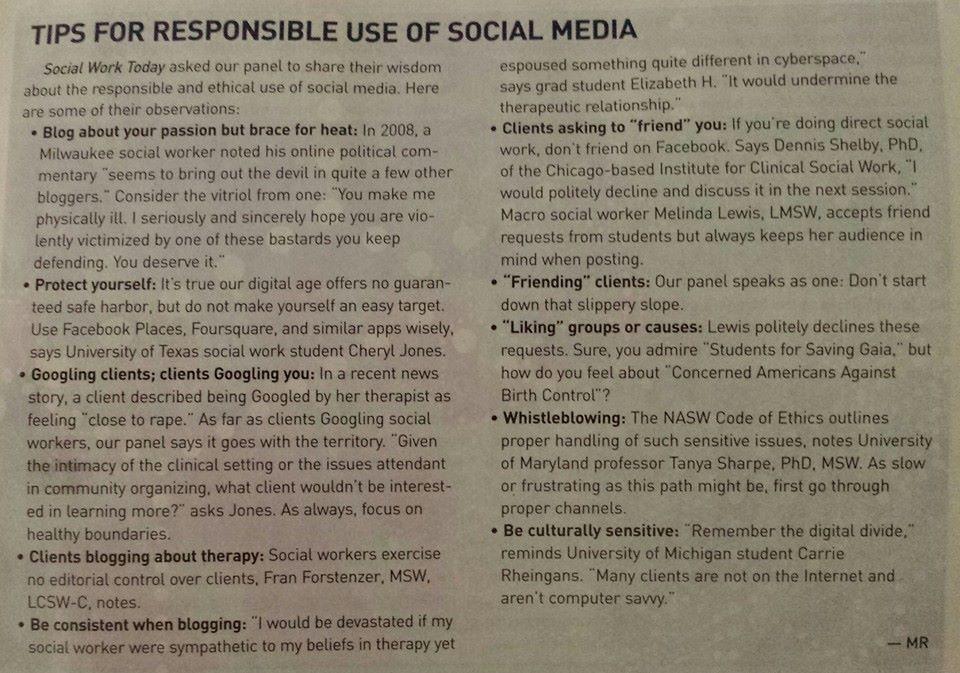
Media: Social Media and Social Work

How to Reduce Risks to Employment When Using Social Media
Hooper, D. (2014). Social Work Helper. Retrieved from: http://www.socialworkhelper.com/2014/09/22/reduce-risks-employment-using-social-media/

A recent decision sanctioning a social worker for a comment on Facebook by the Health Care Professionals Council (HCPC), a United Kingdom regulatory body, sparked an international social work debate on the use of social media in the workplace. Since the decision, I have engaged in multiple conversations via social media with social workers around the globe on this very topic, and I will admit that I have often found myself in the minority arguing against the HCPC’s decision.

Despite the social worker’s comment failing to meet the test for breach of confidentiality, the majority of social workers favoring the HCPC’s decision believe that any comments related to work or a case posted on social media is grounds for termination or discipline even in the absence of identifiers.

The social worker was not disciplined for Breach of Confidentiality, but it was found that her Facebook post “could lead to a Breach of Confidentiality” despite not giving any personal information or descriptors about the client.

I am concerned the HCPC decision will set a dangerous precedent by expanding the scope of breaching confidentiality. The term “could lead to a Breach of Confidentiality” is so broad it could open up liability for social workers outside of the internet sphere.

From the HCPC’s press release on the social worker’s disciplinary action, we actually learn more about the client than we learned from the social worker’s actual comment. The HCPC press release states, “Mrs A, the mother of the children in the case, made a complaint after she searched for the social worker on Google and found the posts, which she said she was “disgusted” by.”, which tells us the complaint was a married woman and parent of the children. Now, these identifier within itself  “could lead to a breach of confidentiality”.

The social worker’s comments only described that she was working on a “domestic violence case among other things”. The client assumed the social worker was referring to her case because it was domestic violence case on the same day as the social workers check-in on Facebook. I don’t know about you, but I’ve had three to five cases go to court on the same day and all of them had a domestic violence element. In the absence of identifiers and a decision from HCPC, the client had no evidence to prove the social worker’s comment was about her case. Sanctions and disciplinary actions in your employment should be based on evidence and not assumptions.

In retrospect, I do believe the social worker’s comments were ill-advised, but it’s not for the reasons you may think. I am definitely against and don’t recommend anyone to commingle your professional life with your personal Facebook account no matter your profession. As matter of fact, some of the comments I see from social workers on Facebook make me afraid for the client’s they are serving. I do and must believe that social workers have the ability to separate their personal beliefs from practice, but you may not be able to “unring that bell” with clients or potential clients after review of your online persona.

The British Association of Social Workers (BASW) have provided me with one of the best social media policy guidelines to help social workers be aware of the pitfalls when using social media personally as well as using social media to obtain information on clients. However, I have yet to see any real solutions that equally address social workers safety with client centered policies. Also, it’s important for us to acknowledge that clients can’t breach confidentiality in their own case. If a client wants to publish online every document you send them, it’s their prerogative, and you should keep this in mind when providing written documents as well as having oral communications with your clients.

Google, Facebook, and Twitter are the three primary areas that cause the greatest concerns for professionals and students. Here are few recommendations that may help you move one step closer to having some peace of mind and keeping your job out of jeopardy.

To Google or Not To Google


As practitioners, we should not be asking whether to Google or Not Google instead we should be giving you the information on how to Google clients and potential clients ethically. According to a recent study by American Psychological Association, 98 percent of clinical, counseling, and school doctoral students reported Googling their clients. It’s time for this profession to readjust our reality for the digital world we are living in.

When Googling a client or anyone for that matter, one must keep in mind that everything on the internet is not true, and it should not be used to penalize without giving the individual a chance to respond. However, for potential clients at a private practice or when making home visits to new clients, a Google search may be a vital tool in assessing social worker safety. 

Dr. Ofur Zur provides one of the most comprehensive resources on whether to “Google or not”, and its complete with scenarios and varying categories to help practitioners decide which category is best for your practice and needs. It also covers how to use informed consent for conducting Google searches at the beginning of the therapeutic relationship.

Tips for Using Facebook


10434000 311155715719496 3315011175902307129 n How to Reduce Risks to Employment When Using Social MediaFacebook is a double-edged sword. When used correctly, Facebook can expand your reach as an expert, increase traffic to your website, and allow you to provide support to others on their professional development journey. Where people get into trouble is when they try to occupy their professional and personal life in the same virtual space. This is not limited to commenting, but it also includes likes, shares, who your friends are, photos, and etc.

I recommend changing your personal Facebook page to a pseudonym with an avatar or baby picture for your profile and cover photos. True friends and family members will know who you are, and Facebook will automatically update your post search history with your pseudonym or nickname. You should also take precautions to enhance the security of your Facebook account.

This will help protect you when clients are actively seeking out content generated by your social media accounts. Secondly, don’t post case related items on your personal Facebook account. If you need advice or an opinion related to a case, message the Social Work Helper Fan Page. I frequently post #SWHelper Team Questions as case study questions to minimize risks to you, and I hope other social work entities will offer similar support for social workers.

If you chose to anonymize your personal Facebook account, I recommend creating a Facebook Fan Page in your professional name which can also help with establishing your professional identity.
  • You can post information and resources for your clients
  • You will no longer need to have embarrassing conversations with clients or coworkers about why you can’t friend them
  • Clients can follow your Fan Page without exposing client’s to each other
  • You can like other Fan Pages your clients may find useful while organizing resources in a central location
  • FB feature allows you to seamlessly switch between your FB account and Fan Page without having to log out
  • You can also make comments, like, share photos, and share posts choosing from either profile
To prevent Facebook from locking your account due to the name change, you should use a shortened or variation of your real and last name, a common name with a long search results history, your maiden name, or your middle name. These are just some of the possibilities you can choose to prevent Facebook from blocking your account. So, if you don’t want to explain to a client or an ethics committee about how your personal beliefs did not affect your decision-making due to memes and content found on your social media account, please take my advice above.

Making the Most of Twitter


Twitter is one of the best social media platforms for making connections and expanding your professional network while enhancing your ability to advocate for the causes you care about. However, there are times when you do need anonymity to protect your employment especially if actively engaging in conversations you don’t want public. Due to my personal philosophy, I don’t post comments or materials that require me to distinguish between my professional and personal identity with the exception of the occasional tweet when I am watching Scandal.

If you are using your professional name, potential networkers and possible opportunities are not going to sort out your professional tweets from your personal tweets. They will all be considered a reflection of you as an individual. “RT does not = endorsement” is not going to cut it. It’s safer to not tweet and/or not retweet something you don’t want to defend, but you could always phrase it a question to ask other’s opinions. Also, I recommend adding the disclaimer “my opinions are my own not my employers” on accounts using your professional name. As a rule of thumb, if your account is going to be opinion filled, use an avatar with pseudonym for anonymity. It’s better to be safe than sorry later.

When using your professional name, it should consist of useful information, advice, inspirational quotes, resources, and/or projects that make you look good professionally. If you are only on twitter anonymously, you are missing opportunities to enhance your professional development. If you are using twitter with your professional name and it’s a private account, you are still doing yourself a disservice. What’s the point of being on Twitter with a private account because it’s difficult for someone to connect with you and no one can retweet your profound 140 characters.

How Do We Move Forward?


Unfortunately, many people have been introduced to social media and online technology as entertainment or to be used as a personal diary. Even if your account is marked private, using instant messaging, email, online technology and/or social media should never be used with an expectation of privacy. You should always assume any information you post online can be privy to public consumption via screen capturing or other measures from anyone who is intent on hurting or exposing you.

In my opinion, the social worker in the above case was condemned because her comment was posted on Facebook. I argue that if said social worker made the same comment in a restaurant, classroom, or other public place would the disciplinary action have been the same? The counter-argument was that Facebook is public and archived by Google which makes it different. I assert we all need to be more careful and aware because we live in a digital age where you can be video tapped or audio recorder via camera phone, vined, viddyed, snapchat, etc. The individual in possession of such digital data can make your actions and comments public without your consent. The medium in which words and actions are transported is irrelevant, and it stifles our ability to move the conversation forward instead of focusing on best practices.

Most importantly, one of the biggest issues in the above case not being addressed is that fact the client went onto Google searching for the social worker in question. Community Care UK reported that 85% of social workers reported being harassed or verbally abused on the job. Whether the client was acting with nefarious intent or in preparation for a pending court case, we simply don’t know. However, social worker safety should be just as important as client confidentiality. The biggest mistake made by the disciplined social worker was her checking in on Facebook thereby giving the time and location for when she would be in court. Why are we not being programmed to think about social worker safety as much as client confidentiality is drilled in our heads?

As a profession, we can not begin the journey of leveraging online technology and social media to advance social work because we are stuck having conversations about account creation, security, and ethical use. These things should always be ongoing conversations, but we have got to start making advances in tech education and training. Agencies, associations, and social work faculty cannot adequately answer or provide solutions because most don’t use social media or they utilize outside firms to meet their social media needs. There is nothing wrong with contracting out to meet the needs of your organization, but we must also have mechanisms in place to address social workers’ technological IQ at the micro and mezzo levels.

We must develop continuing education credits, foundational course work, and in-service trainings to properly prepare current and future social workers for practice in the digital age. Social Work education is expensive and students should be demanding that they get the best resources and training during their education especially when they can be fired or disciplined for it later.

Most importantly, we have a duty to our students and professionals to assist them in harnessing all the advantages that social media and technology can provide. To learn more about available social media workshops and consultations, visit here, and I look forward to your comments and questions.
View image on Twitter

Thursday, October 9, 2014

Professional Development: Dalhousie School of Social Work Continuing Education

Counselling Skills Level 2

More Counselling Skills - Building on the Basics: Online Certificate Program

Registration will remain open until the course is full.

Jill Ceccolini and Debbie van Horne have designed Counselling Skills Level 2 to build on the skills developed in the Counselling Skills Level 1 Certificate Program. Practice intervention tools and techniques, explore the use of self within the counselling relationship, and learn to articulate your own philosophy and approach to counselling in this 6-week interactive, online Certificate Program.


Oct 20 - Nov 30

More Information

The Heart of Helping

Understanding Vicarious Trauma & Compassion Fatigue: Online Workshop

Registration deadline has been extended to Friday, October 10.

Vicarious trauma and compassion fatigue are common occupational hazards for professionals in high-care fields. Lynda Monk designed this 4-week online course to teach those in the helping, human service, and healthcare professions about vicarious trauma and compassion fatigue -- what they are, how they manifest, and how to prevent and/or intervene with these negative effects.


Oct 14 - Nov 9

More Information

Painful Emotions

The Clinical Treatment of Anger and Shame: Online Workshop

In this online workshop Ron Potter-Efron provides practical and effective approaches to dealing with anger and shame from behavioural, cognitive, affective, and existential perspectives. Additionally, two models for more detailed work with clients are offered: an "anger styles" model that helps counsellors treat eleven varieties of anger, and the "four spheres of self" shame model that addresses increasingly deeper levels of the shame experience.


Nov 3 - Nov 30

Registration deadline: Oct 10

More Information 

Continuing Education Program, School of Social Work, Dalhousie University
coned@dal.ca www.dal.ca/socialwork 902.494.6899

Tuesday, October 7, 2014

Professional Development: Satir Healing From Trauma workshop

Helping People Change Workshop Series: Professional Growth Workshop

Healing From Trauma Using Satir Transformational Systemic Therapy
with Kathlyne Maki-Banmen, MA, RCCIndividual, Couple and Family Therapist

When: December 6 & 7, 2014 9 am – 5 pmWhere: Phoenix Centre 13686 – 94A Street, Surrey, BC, Canada V3V 1N1Cost: $300 per person (SIP Member and Early Bird Rates Available)
(Payment accepted via PayPal, Credit Card or Cheque)

About The Program:

When a trauma has occurred, the impact of the trauma can affect a person's life for a long time to come. The severity of the impact of a specific trauma is influenced by the person's past experiences and traumas. Research of the neurological and endocrine systems make it very clear that it is possible to heal from the impacts of trauma. It is possible, through a deeply experiential, transformational therapeutic process, to greatly reduce the impact of the trauma and help the client grow in a positively directional way towards peace, joy and empowerment.

This workshop will demonstrate ways to begin the healing process soon after trauma occurs as well as with past traumas. This will include:

  • How to release the traumatic energies held in the physical neurological system as “body memory”.
  • How to help the client change their intrapsychic system including their emotions, perceptions, expectations and behaviours
  • How to use the important role spirituality has in the healing process.
  • How to help families heal from the impact of trauma so that they can connect and support each other in healthy ways.
The workshop leader will incorporate lecturettes, discussion, experiential exercises, small group work and skill development practice as part of the program. This 2 day workshop is intended for helping professionals working with clients in therapy.

For more information see attached brochure or contact:

Cindi Mueller, Administrator
Satir Institute of the Pacific
604-634-0572
admin@satirpacific.org

satiradmin@shawbiz.ca

Professional Development: Suicide Assessment and Mindfulness trainings

Fall Trainings Available

Benefit from learning how to help prevent and respond to crisis and suicide or enhance your resiliency and well-being through mindfulness. The Crisis Intervention and Suicide Prevention Centre of BC is a non-profit organization committed to helping people help themselves. Our Fall/Winter 2014 trainings are rich and varied.
Together we can make our communities safer from suicide.

safeTALK

Learn suicide warning signs. An engaging and interactive half-day workshop that prepares anyone over the age of 15 to identify persons with thoughts of suicide and connect them to suicide first aid resources. Learn more and register.
Scheduled Dates (all 9am to 12:30pm):
  • Tuesday, October 21: North Shore Community Resources Society
  • Monday, October 27: Crisis Centre
  • Friday, November 7: Crisis Centre
  • Thursday, November 20: Burnaby Community Services
  • Saturday, December 6: Crisis Centre

Applied Suicide Intervention Skills Training (ASIST)

ASIST workshop is for caregivers who want to feel more comfortable, confident and competent in helping to prevent the immediate risk of suicide. Learn suicide first aid in this two-day, highly interactive, practical, practice-oriented training. Learn more and register.
Scheduled Dates (8:45am to 5pm both days):
  • Thursday & Friday, October 23 & 24, Crisis Centre
  • Thursday & Friday, December 11 & 12, Crisis Centre

Assessing Suicide Risk in Kids (ASK)

A unique training opportunity for this Fall only. A one-day workshop for professional helpers, working with or caring for children, who want to learn more about suicide prevention for children from kindergarten to middle-school. Learn more and register.
Scheduled Date (9am to 5pm):
  • Thursday, October 30, Crisis Centre

Mindfulness 101

A half day, practice-based introductory session that explores what mindfulness is and how it can help us in our lives. Learn four mindfulness tools. Learn more and register.
Scheduled Date (9am to 12pm):
  • Friday, November 28, Crisis Centre

For more details on all of our training opportunities, visit http://www.crisiscentre.bc.ca/training or call 604.872.1811.

Monday, October 6, 2014

Critical Analysis: Learning from Child in Care Deaths


Lessons learned from inquiries into foster child deaths usually don't get discussed with front line social workers, an expert in child protection says.

"Inquiries keep talking about the same practise problems ... We're not having enough conversation with front-line social workers about what the inquiries are telling us," said Peter Choate, a social work professor at Calgary's Mount Royal University who has studied almost 1,000 deaths of children in care in Canada, the U.K., New Zealand, Australia and the United States.

Inadequate case assessments, training and supervision are common themes emerging from the inquiries, Choate said.

Good case plans depend upon thorough assessments that include people who are too often "invisible" - the child and new adults in the child's life, he said.

Too often children at risk are not actually seen or talked to by social workers. New boyfriends or other adults who are in the picture are ignored.

Social workers need to be willing to question information they receive and they need to be able to talk with supervisors about what they've gathered, Choate said.

"How do we get our social workers and child protection workers to be more reflective about the information they need and how to gather that information and what to do with that information? What are the barriers to getting good assessments?" Choate said in an interview Wednesday, at the opening of a threeday conference for social workers and policy-makers from across Western Canada.

The inquiries show that supervisors who discuss findings and decisions made with the front-line social workers yield better results, he said.

"If the assessment's been done well and the family's really been listened to in the assessment process, then outcomes are better."

Social workers' skills can't be taken for granted. Newly graduated professionals still need years of supervision and experience, in addition to specialized training in things like addictions, mental health, sexual assault, physical and emotional abuse, child development and risk.

Child death inquiries must create conversations between the public, families, child protection agencies and government about learning how to do a better job, he said.

"If they're about shame and blame, nothing useful comes from them because people take cover, they don't want their case to be the next one in the newspaper.

"It's tough work. Turnovers are high. If we pay for enough social workers, provide them with good supervision and support and give them the opportunity to do the job well, then our turnovers will go down," Choate said.

The funding problem is acute in federally funded First Nations child welfare authorities, which are said to receive about 22 per cent less funding than provincially funded agencies. "You have a moral, ethical question of why would you be funding First Nations child welfare at a lower rate," Choate said.

"If we want to make the apology that (Prime Minister Stephen) Harper made about the tragedy of residential schools, then you have to be willing to make that apology real, to fund the work necessary to repair that, which is partially through funding the child welfare resources available to First Nations communities."

The funding disparity is the basis of a discrimination complaint against the Government of Canada that was brought to the Canadian Human Rights Commission by the First Nations Child and Family Caring Society of Canada and the Assembly of First Nations.

A tribunal has been hearing evidence on the matter since early 2013. Final arguments will be heard Oct. 20 to 24 in Ottawa.

badam@thestarphoenix.com


Wednesday, October 1, 2014

Global Social Work: In the UK Almost One in Ten social workers considering quitting due to stress

Almost one in 10 social workers forced to brink of quitting as stress takes its toll

The pressure of the job has never been greater, social workers tell Community Care and TMP job-seeking study

Schraer, R. (2014. Community Care. 

Nearly one out of every 10 social workers is looking for a job outside the profession because of factors including stress and high caseloads, an in-depth study into social worker job-seeking by Community Care and advertising agency TMP has found.

The study surveyed 2,100 social workers and found that 8% were looking to leave the profession. Of those looking to leave social work, 23% said the job was too stressful or affecting their health while 20% cited high caseloads.

Others talked of too much paperwork (17%), not spending enough time with clients (14%) and the impact of budget cuts (12%).

“I love social work but sharing people’s misery is becoming too much,” one local authority social worker told the study.

Another said: “I am sick to death of tokenism, political correctness, risk averse, process-led and incompetent management driven only by the need to appease Ofsted.”

What do social workers look for in a new employer?- see our handy picture guide

More pressure

Even those not intending to leave social work said the stress of the job is taking its toll with 94% saying there is more day to day pressure on social workers than ever before.

“My stress levels are perpetually too high and my mental and physical health suffers as a result,” said one social worker. “Most nights I wake up in the night worrying about work I have not had time to do. I struggle to enjoy life outside work as I’m so exhausted.”


Stressed social workers speak up:
“With high caseloads and a lack of support, I feel unable to do a good job”
“There is a consistent disbelief of workers’ stress levels and difficulties in management of such high caseloads”
“The management structure is top-heavy and the blame culture is still prevalent”
“Before the cuts, I loved my job. Now it is impossible for all of us – not enough staff and unrealistic expectations from managers”
The study also asked social workers what attributes would most tempt them to jump ship to another social work job.

Almost half (49%) said a better work-life balance while 48% cited better pay. Opportunities for new challenges or experiences was mentioned by 44% and 39% said a job that involved less stress.

Just over half of social workers (52%) would consider relocating for a job.

Poor management

In-depth interviews with 20 social workers carried out for the study revealed that poor management is often a reason why they would consider hunting for a new post.

A lack of experienced staff on teams was also cited as a reason to leave.

One social worker said: “There are so many inexperienced staff here I feel that it’s dangerous and I don’t want to be exposed to that.”

For social workers who wanted to remain with their current employer, respectful and supportive management was a common reason as was having opportunities for career development and a good team ethic.

“I work with a great team and a great manager,” said one. “I feel more loyal to them; if the team changed, I’d feel differently.”

Read why six out of 10 social workers would not recommend their employers to another social worker

Staying put

Yet even when offered a new job many social workers turned it down.

Just over a quarter (26%) of social workers surveyed, who had been offered another job in the past three years, decided to stay where they were.

Of those who rejected the chance to change jobs, 28% said they were concerned about starting a new job during a recession while 9% stayed because they were offered a promotion.

Another 6% said they turned down the job offer because of a pay increase.

Find out what’s going wrong in the recruitment process